


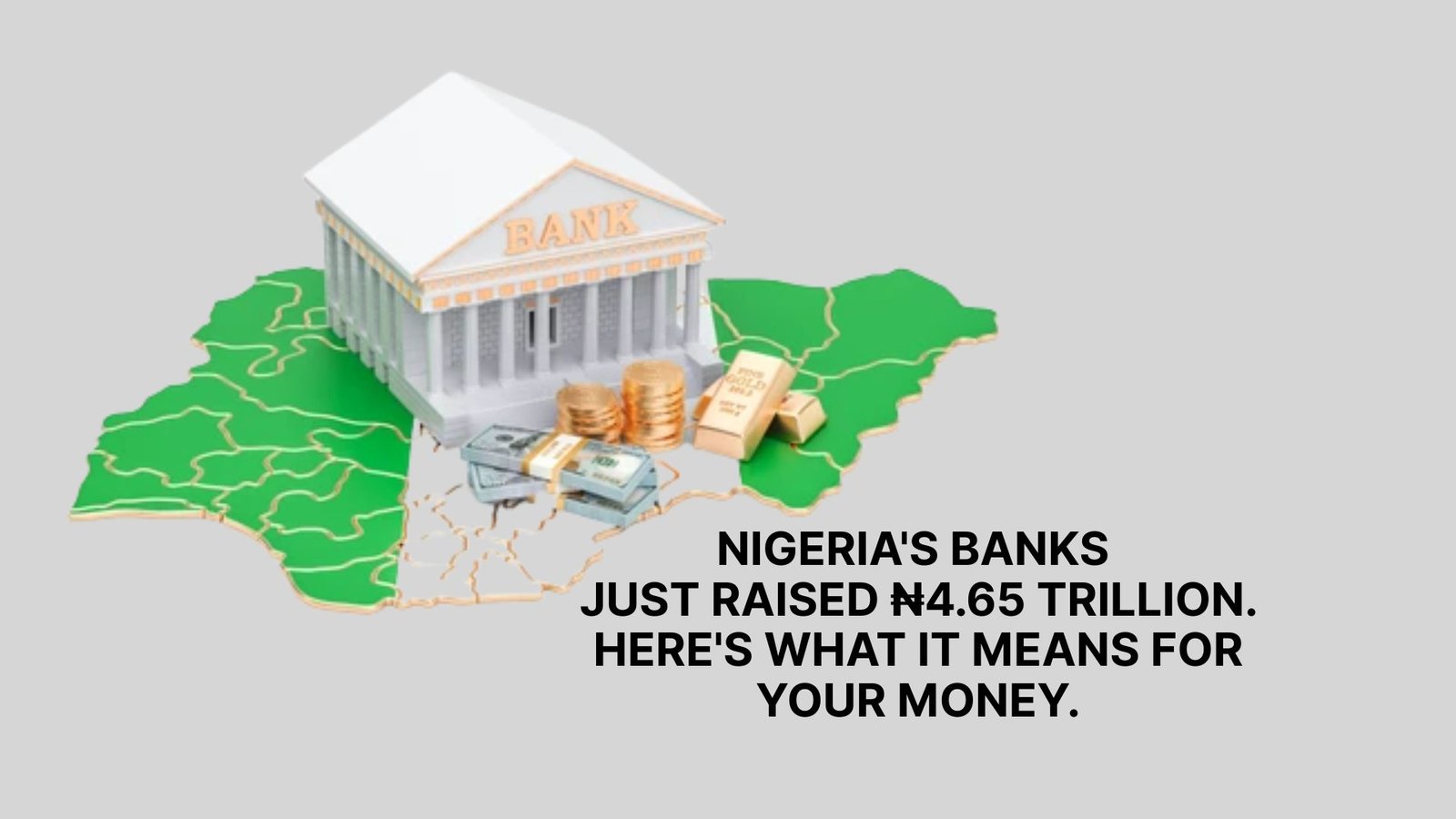
Completed Bank Recapitalization: The 2026 Bank Recapitalization in Nigeria is officially complete.
Just this week, the Central Bank of Nigeria (CBN) announced that the long-awaited banking recapitalization exercise is officially over. 33 banks met the new minimum capital requirements and together raised ₦4.65 trillion in fresh capital over the past 24 months. About 72.55% of that money came from Nigerian investors, with the rest from outside.
For many of us grinding in Nigeria, or sending money back from abroad, the big question is simple: How does this affect my own money?
The honest answer: It strengthens the system that holds your savings and gives banks more room to lend. But the real benefits for everyday people and small businesses will take time to show up.
Here’s the clear picture.
Why the CBN Ordered Bank Recapitalization in Nigeria
Nigeria’s banks were operating on capital bases that had not kept pace with inflation, naira depreciation, or the scale of the economy. The CBN mandated significant increases, in some cases up to ten times higher depending on licence type, to build a sector capable of absorbing shocks without threatening deposits or triggering a crisis.
The result is a banking system with higher capital adequacy ratios and thicker loss-absorption buffers. Governor Cardoso has stated publicly that the exercise positions banks to actively support Nigeria’s economic growth targets, which the World Bank projects at around 4.3–4.5% for 2026, driven partly by stronger financial intermediation.
No bank failed outright during the process. Services continued normally throughout.
What This Means for Your Savings
Your deposits are now sitting in a more stable system. Stronger capital means banks have a larger cushion before depositor funds are ever at risk. The Nigeria Deposit Insurance Corporation (NDIC) still protects up to ₦5 million per depositor per bank, but the banks themselves are now better positioned to protect everything above that threshold.
On the practical side, watch for improved savings products in the second half of 2026. With stronger balance sheets, some banks are expected to compete more aggressively for retail deposits through better fixed deposit rates and high-yield savings accounts. Nairametrics noted in March 2026 that post-recap banks will need to deploy fresh capital productively, which creates incentive to grow their retail deposit base.
That said, do not expect savings rates to suddenly beat inflation overnight. That structural gap takes time to close.
What to do: Review where your emergency fund sits. Spread larger amounts across two or three fully compliant institutions for extra security. Compare current fixed deposit rates, even a 1–2% difference compounds meaningfully over a year.
The Lending Question (Will Banks Actually Give Out Money?)
This is where small business owners are watching most closely, and where the cautious optimism is most warranted.
Banks now have more capital to lend without hitting regulatory ceilings. According to the CBN’s own data cited by Nairametrics, over 70% of registered businesses in Nigeria are SMEs, yet there remains a financing gap estimated at ₦13 trillion. Post-recap banks are widely expected to target this gap more aggressively as a growth strategy, lending to productive SMEs at scale is one of the few ways to deploy ₦4.65 trillion in new capital responsibly.
Realistic expectation: lending will not become cheap immediately. The CBN has directed banks to stress-test their new loan portfolios before scaling up. High interest rates will likely persist in the short term. But by mid-to-late 2026, the conditions for increased SME credit should improve meaningfully.
If you have an existing loan, your current terms are unchanged.
Read Also: Beginner’s Guide to Investing in Nigeria Without Losing Sleep
Where This Leaves Your Portfolio
- Bank stocks: Many listed banks saw their market value rise during the recap process. If you already hold shares in compliant banks, this is generally positive for long-term stability, though there can be short-term dilution effects from new shares issued.
- Treasury Bills and Fixed Income: Stronger banks are better at intermediating funds, which could support more activity in government securities.
- Other opportunities: With bigger balance sheets, banks may partner more with fintechs and investment platforms (think Risevest, Bamboo, Cowrywise). This could indirectly open more dollar or diversified options for regular investors.
- Real estate and agribusiness: More bank capital could eventually support bigger project financing in these areas.
| Asset / Opportunity | Post-Recap Outlook | What to Watch |
|---|---|---|
| Bank stocks (NGX-listed) | Generally positive long-term; some short-term dilution from new share issuance | Earnings reports Q2–Q3 2026 for lending growth signals |
| Treasury Bills & Fixed Income | Stronger banks improve government securities intermediation | CBN rates and auction results |
| Fintech-linked investments (Risevest, Bamboo, Cowrywise) | Banks may partner more with platforms; indirect benefit for retail investors | New product announcements mid-2026 |
| Agribusiness & Real Estate | Larger bank balance sheets support bigger project financing | Sector-specific loan announcements from Tier-1 banks |
The World Bank’s April 2026 Nigeria outlook flags that the real test of recapitalisation is whether banks lend to the productive economy rather than parking capital in government securities. That distinction matters for how quickly the benefits reach ordinary Nigerians.
For diaspora investors: stronger banks create a better environment for remittance-linked investment products and investment-backed loan facilities, watch for these from Tier-1 banks in the second half of the year.
Important reality check: Recapitalization alone won’t fix high inflation or FX challenges. Nigeria’s economy is still projected to grow around 4.3–4.5% in 2026, with inflation hopefully easing further. The real test is whether banks actually lend more to the real economy instead of just holding safer government securities.
Practical Action Steps You Can Take in 2026
- Verify your bank’s compliance status. All 33 compliant banks are publicly listed on the CBN website. If yours is not on the list or is undergoing further restructuring, consider moving larger deposits to a fully compliant institution.
- Review your savings rate. Compare fixed deposit rates across two or three strong banks today. Nigeria’s headline inflation stood at 15.06% in February 2026, according to the National Bureau of Statistics (NBS) down sharply from 26.27% the same period last year, but still outpacing most savings products. Factor that gap into every savings decision you make this year.
- Prepare your loan documentation early. If you run a small business and plan to approach a bank for credit in 2026, start now. A clean business plan, six months of account statements, and any available collateral puts you ahead of the queue when banks start expanding SME lending.
- Diversify investment exposure. Rather than concentrating in one bank stock, consider diversified exposure through regulated investment apps. Watch bank earnings in Q3 2026 for concrete signals of increased lending.
- Stay focused on your own fundamentals. Recapitalisation strengthens the soil, but your emergency fund, multiple income streams, and low consumer debt are still the seeds that matter most.
The Bottom Line
The ₦4.65 trillion recapitalisation is the most significant structural reinforcement Nigeria’s banking sector has seen in years. Your deposits are safer, lending conditions should gradually improve, and the environment for productive investment is stronger than it was twelve months ago.
But policy alone does not pay your rent or fund your business. Watch how quickly the banks actually lend. That is the only number that matters for people like us.
For us, we believe every naira is a seed. This recap strengthens the soil. Now it is on the banks, and on us, to plant wisely.
Have you noticed any changes with your bank since the exercise ended? Drop your experience in the comments or share this with someone in your WhatsApp group who is asking the same questions.
Take a dive into what bank recapitalization means for SEMs.