



PAYE. Three letters that show up on every Nigerian payslip.
Most employees know it means tax. Most employers know they have to remit it. But few people on either side of that transaction fully understand how it works, what the rules are, how it changed in 2026, and what happens when someone gets it wrong.
This is the complete guide. Whether you are an employee trying to understand your payslip, an HR manager updating payroll for the new law, or a small business owner who has just taken on your first staff, this post covers everything you need to know about PAYE Tax in Nigeria under the Nigeria Tax Act (NTA) 2025.
It is a long read by design. Use the section headings to navigate to the part most relevant to you.
PART A: FOR EMPLOYEES
A1. What Is PAYE and How Does It Work?
PAYE stands for Pay-As-You-Earn. It is the system by which personal income tax is collected from employees at source, meaning your employer deducts it from your salary before you ever receive it and sends it directly to the tax authority on your behalf.
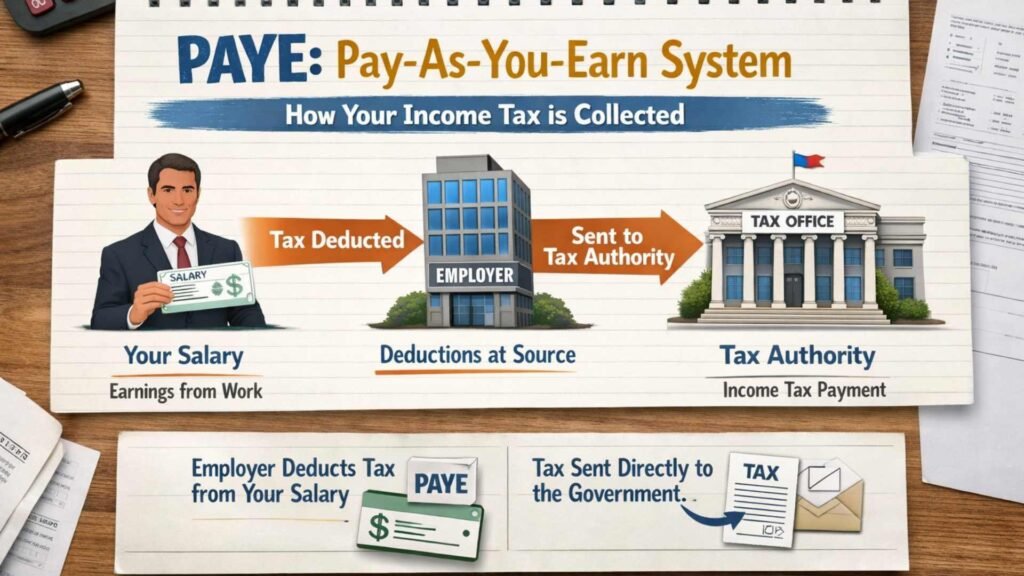
The tax authority collecting your PAYE is usually your State Internal Revenue Service, for example, if you receive salary in Lagos, the Lagos Internal Revenue Service (LIRS) receives your taxes, not the federal government.
Your PAYE goes to whichever state you reside in, not necessarily where your company is registered. This is an important distinction that sometimes causes confusion when a company is registered in Lagos but has employees living in Abuja or Port Harcourt.
The Nigeria Tax Act 2025 (NTA 2025), which took effect on 1 January 2026, is now the governing law for PAYE in Nigeria. It repealed the old Personal Income Tax Act (PITA) and introduced new bands, new deductions, and updated compliance rules.
Who pays PAYE? Any individual in employment earning income above N800,000 per year (after approved deductions) is liable for PAYE. Self-employed individuals are not subject to PAYE but are taxed under the same bands through direct assessment.
A2. What Income Is Subject to PAYE?
The NTA 2025 is very explicit on this. It is broader than most employees realise.
Under the NTA 2025, all forms of employment income are included in the PAYE base. This covers:
- Basic salary
- Housing allowance
- Transport allowance
- Utility allowance
- Meal allowances
- Leave allowance (only the amount above the exempt 10% of basic salary)
- Entertainment allowances
- Any other cash payments from employer to employee
Benefits in kind are also taxable. If your employer provides you with accommodation, a car, or other assets for personal use, a value is assigned to that benefit and it is included in your taxable income. The NTA 2025 introduced defined valuation rules for this: employer-provided assets are valued at 5% of the cost of the asset per year.
What is not subject to PAYE includes contributions to approved pension funds, reimbursements for legitimate business expenses (with receipts), and terminal benefits within the N50 million exemption threshold.
A3. The New 2026 Tax Bands at a Glance
These are the official bands under the NTA 2025, effective 1 January 2026.
| Annual Chargeable Income | Rate | Tax on Band (Max) | Cumulative Tax |
|---|---|---|---|
| First N800,000 | 0% | N0 | N0 |
| N800,001 to N3,000,000 | 15% | N330,000 | N330,000 |
| N3,000,001 to N12,000,000 | 18% | N1,620,000 | N1,950,000 |
| N12,000,001 to N25,000,000 | 21% | N2,730,000 | N4,680,000 |
| N25,000,001 to N50,000,000 | 23% | N5,750,000 | N10,430,000 |
| Above N50,000,000 | 25% | No cap | N10,430,000+ |
Remember: these bands apply to your chargeable income, and not your gross salary. Your chargeable income is what remains after subtracting all approved deductions. We cover the deductions in detail in the next section.
The biggest change from the old law: the tax-free threshold jumped from N300,000 to N800,000. For most Nigerian salary earners, this single change accounts for the bulk of their tax saving in 2026.
A4. What Deductions Can Reduce Your PAYE?
These are the deductions you are legally entitled to claim before the tax bands are applied to your income.
| Deduction | How It Is Calculated | Cap | Documentation Required |
|---|---|---|---|
| Pension (employee portion) | 8% of pensionable emoluments (basic, housing, transport) | No cap | PFA statement |
| NHF Contribution | 2.5% of basic salary | No cap | NHF registration slip |
| NHIS / Health Insurance | Actual premium paid | No cap | Insurance certificate |
| Life Insurance Premium | Actual premium paid | No cap | Policy document |
| Rent Relief | 20% of annual rent paid | N500,000 | Tenancy agreement + receipts |
| Voluntary Pension (above 8%) | Actual amount contributed above mandatory 8% | No cap | PFA confirmation |
Important notes on deductions
Pension: Only the employee’s 8% contribution is deductible, not the employer’s 10%. Also, pension is calculated on pensionable emoluments only (basic salary, housing, and transport allowances), not your full gross package.
NHF: You must actually be enrolled in the National Housing Fund through your employer to claim this. If you are not registered, you cannot deduct it. Ask your HR team.
Rent Relief: This is the biggest new addition under NTA 2025. You can deduct 20% of the annual rent you actually pay, capped at N500,000. The key word is ‘actually.’ You need a tenancy agreement and payment receipts. If your employer provides your housing, you cannot claim this relief.
Voluntary Pension: Any pension contributions above the mandatory 8% are also tax-deductible. This is underused. If you are looking for a legitimate way to reduce your tax bill while saving for retirement, this is it.
A5. How to Calculate Your PAYE: Step by Step
A complete worked example for a N400,000/month (N4,800,000/year) employee.
| Item | Amount |
|---|---|
| Gross Annual Salary | N4,800,000 |
| Less: Pension (8% of N4,800,000) | (N384,000) |
| Less: NHF (2.5% of basic; basic = N2,000,000) | (N50,000) |
| Less: Rent Relief (20% of N1,200,000 rent paid) | (N240,000) |
| Chargeable Income | N4,126,000 |
| Tax Calculation by Band | |
| First N800,000 @ 0% | N0 |
| Next N2,200,000 @ 15% (N800,001 to N3,000,000) | N330,000 |
| Remaining N1,126,000 @ 18% (N3,000,001 to N4,126,000) | N202,680 |
| Total Annual Tax | N532,680 |
| Monthly PAYE Deduction (divide by 12) | N44,390 |
| Effective Tax Rate (N532,680 / N4,800,000) | 11.1% |
This employee earns N400,000 per month but only pays N44,390 in PAYE per month. That is an effective rate of 11.1%, well below the 18% marginal rate that applies to part of their income. The progressive bands and the deductions work together to bring the effective rate down.
To calculate your own figures without doing the maths manually, use the NairaSeed Tax Calculator. Enter your gross salary and deductions and the calculator shows you every line of this calculation, band by band, in under 60 seconds.
A6. Your Payslip: What to Check Every Month
Now that you know how PAYE is calculated, here is what to look for on your monthly payslip to make sure your employer is doing it correctly.
- Gross salary shown correctly: All components of your package should be listed. If allowances are missing, the gross income being taxed may be wrong.
- Pension deduction is 8%: Verify that pension is being deducted from pensionable emoluments (basic, housing, transport), not from the full gross if other allowances are included.
- PAYE is calculated on chargeable income, not gross: If your payslip shows PAYE calculated directly on your gross salary without first subtracting pension and other deductions, your employer may be over-deducting.
- The NTA 2025 bands are being used: Some payroll systems were slow to update after January 2026. If your PAYE looks higher than expected, compare it against the new bands using the NairaSeed calculator. If your employer is still using the old PITA rates, they need to correct this.
- Your TIN is on record: Under the NTA 2025, all employees must have a valid Tax Identification Number (TIN). If your TIN is not on your payslip or your HR records, get one from your State IRS or the NRS online portal.
A7. What If You Have Income Outside Your Salary?
PAYE only covers your employment income. If you have other income sources, you are responsible for declaring and paying tax on those separately through a self-assessment or direct assessment filing with your State IRS.
Income sources outside PAYE that require separate filing include:
- Rental income from property you own
- Freelance or consulting income
- Dividends from shares (though withholding tax may already apply)
- Business income from a side business
- Interest income above the exempt threshold
You file an annual income tax return by 31 March each year for the previous tax year. Failing to declare income that is not captured by PAYE can attract penalties under the NTA 2025.
PART B: FOR EMPLOYERS AND HR TEAMS
B1. Your Legal Obligations as an Employer Under NTA 2025
If you employ people in Nigeria and pay them a salary, you are a withholding agent for the government. The NTA 2025 is explicit: the obligation to deduct and remit PAYE sits entirely with the employer, not the employee.
Your core obligations are:
- Register as an employer with the relevant State Internal Revenue Service in each state where your employees are resident.
- Deduct the correct PAYE from every employee’s salary every month using the NTA 2025 bands and rules.
- Remit the total PAYE deducted to the appropriate State IRS by the 10th of the following month.
- Maintain accurate payroll records for all employees including TINs, gross income, deductions, and PAYE amounts.
- File annual PAYE returns (Form H1 equivalent under the new law) with the State IRS by 31 January each year.
- Issue employees with a certificate of tax deducted (equivalent to a P60 in other jurisdictions) for their annual records.
Key change under NTA 2025: Employers who engage contractors or vendors must verify that those contractors have a valid TIN. Engaging an unregistered contractor now attracts a N5,000,000 penalty. This applies to employment payments, not just services, so the stakes are high.
B2. How to Structure Your Payroll for NTA 2025 Compliance
Step 1: Identify pensionable emoluments
Pension is calculated only on basic salary, housing allowance, and transport allowance. The employee’s 8% (and your employer 10%) is based on this subset of the package, not the full gross. Get this right first because it affects the chargeable income calculation.
Step 2: Collect deduction documentation from employees
Rent relief, NHIS, life insurance, and NHF deductions all require documentation. Build a process to collect and verify these from employees at the start of each tax year, ideally in January. Without documentation, you cannot apply the deduction even if the employee genuinely qualifies.
Step 3: Calculate chargeable income per employee
For each employee: Gross Income minus Pension (8% of pensionable emoluments) minus NHF (if enrolled) minus NHIS minus Life Insurance minus Rent Relief minus any other approved deductions equals Chargeable Income.
Step 4: Apply the NTA 2025 bands
Apply the six bands progressively to each employee’s chargeable income. Most payroll software should handle this automatically if it has been updated for NTA 2025. If you are using a spreadsheet, build the band calculation as a formula that works through each tier.
Step 5: Divide by 12 for the monthly deduction
The annual PAYE figure is divided by 12 to arrive at the monthly PAYE deduction. This is what comes off the employee’s monthly payslip.
Step 6: Remit to the correct State IRS
PAYE is remitted to the State IRS of the state where each employee is resident, not where your company is registered. If you have employees in multiple states, you will be remitting to multiple State IRS offices. Some large employers use a consolidated filing approach through the Joint Revenue Board. Confirm the process with your tax adviser.
B3. Penalties for Getting PAYE Wrong
The NTA 2025 introduced significantly stiffer penalties than the old PITA. Do not take compliance lightly.
| Offence | Penalty | Authority |
|---|---|---|
| Failure to deduct PAYE | Employer liable for the full undeducted tax plus interest | State IRS |
| Late remittance of PAYE | 10% of tax due plus interest at prevailing CBN rate | State IRS |
| Under-deduction | Employer liable for shortfall; NTA 2025 introduced stiffer penalties for this | State IRS |
| Failure to file annual returns | N500,000 per year for a company; additional penalties may apply | State IRS |
| Engaging contractors without valid TIN | N5,000,000 fine under the NTA 2025 | NRS / State IRS |
The most important thing to understand about PAYE penalties is that the liability falls on the employer, not the employee. If you under-deduct PAYE, the State IRS will come to you for the shortfall, even if the employee has already received and spent the money. You cannot go back to the employee to recover it after the fact without their agreement.
B4. PAYE Compliance Calendar
A simple reference for HR and finance teams.
| When | What | Who |
|---|---|---|
| Monthly (by 10th) | Remit PAYE deducted the previous month to the State IRS | All employers with salaried staff |
| January each year | Update payroll systems for any changes to tax bands, rates, or thresholds | HR / Payroll teams |
| On employee joining | Obtain employee TIN, verify it with the NRS, and register the employee for PAYE | HR |
| By January 31 each year | File annual PAYE returns with the State IRS listing all employees and total taxes deducted | Employer |
| On employee leaving | Issue tax clearance certificate request form; remit any outstanding PAYE | HR / Finance |
B5. Common Employer Mistakes to Avoid
- Using the wrong gross for pension: Deducting pension from the full gross package instead of just the pensionable emoluments (basic, housing, transport) will result in a higher pension deduction and a lower chargeable income than intended. Check your payroll setup.
- Not updating payroll after 1 January 2026: Some companies were still running the old PITA bands months into 2026. If any payroll runs after January 2026 used the old rates, you have under-deducted (or over-deducted in some cases) and the returns for those months will need correction.
- Remitting to the wrong State IRS: PAYE follows the employee’s state of residence, not the employer’s registered state. If all your Lagos-registered company employees live in Lagos, this is not an issue. But if you have remote staff in Abuja, Enugu, or Kano, you must remit their PAYE to those respective State IRS offices.
- Not collecting TINs for all employees: Every employee must have a TIN. New hires without one should obtain it before their first payroll run. You are required to include TINs in your annual PAYE returns.
- Ignoring benefits in kind: Company cars, company accommodation, and other non-cash benefits have a taxable value under the NTA 2025. If your payroll is not capturing these, you may be under-declaring taxable income for affected employees.
PART C: FREQUENTLY ASKED QUESTIONS
Is PAYE the same as income tax?
Yes, for employees. PAYE is simply the mechanism by which personal income tax is collected from salary earners at source. The underlying tax is personal income tax. The bands, rates, and deductions under the NTA 2025 apply whether you are paying through PAYE (as an employee) or through direct assessment (as a self-employed person).
My employer pays tax on my behalf as part of my package. Is that correct?
Some employers offer ‘grossed-up’ salaries where they absorb the tax cost. This is legal but it creates a circular calculation because the employer’s payment of your tax is itself a taxable benefit in kind. If your contract says your employer pays your tax, your payroll team needs to handle this carefully. The value of the tax paid on your behalf must be added to your taxable income, which then generates more tax.
I changed jobs in 2026. How is my PAYE handled?
Your new employer calculates PAYE based on your salary with them. They do not carry forward income from your previous employer. However, at the end of the tax year, you are responsible for filing an annual return that consolidates all income from both employers. If there is a shortfall (because each employer treated you as if you had the full benefit of the zero-rate band), you will owe the difference.
I work remotely for a foreign company. Do I pay PAYE?
Yes, if you are resident in Nigeria. Under the NTA 2025, Nigerian residents are taxed on their worldwide income. Income earned from a foreign employer is still subject to Nigerian personal income tax. You would typically file this through direct assessment with your State IRS since there is no Nigerian employer to withhold on your behalf. Double taxation treaties between Nigeria and the employer’s country may provide relief in some cases.
What is a TIN and how do I get one?
A TIN (Tax Identification Number) is a unique identifier issued by the tax authority to every taxpayer. Under the NTA 2025, all taxable persons must have one. You can get a TIN online through the Nigeria Revenue Service (NRS) portal, through your State IRS, or through some banks. It is free. Your employer should have your TIN on file. If they do not, getting one should be a priority.
Can my employer deduct more PAYE than they should?
Yes, it happens. Over-deduction can occur if the payroll system is using incorrect rates, not applying deductions properly, or treating allowances incorrectly. If you suspect you have been over-deducted, calculate your expected PAYE using the NairaSeed Tax Calculator and compare it to your payslip. If there is a gap, raise it with your HR or finance team in writing. Overpayments can generally be applied as a credit against future PAYE or refunded through the State IRS.
Your Might Also Like:
This guide is part of a complete NTA 2025 content series on NairaSeed. Explore the posts below for more detail on specific topics.
- Nigerian PAYE Tax Calculator 2026: How Much Tax Will You Actually Pay? (use the calculator to find your exact figures)
- How to Calculate Your Take-Home Pay in Nigeria (2026 Edition) (what your new take-home means for your budget and savings)
- Nigeria’s New Tax Bands Explained: What Every Salary Earner Must Know in 2026 (the progressive band system in plain English)
- NTA 2025 vs Old PITA: Are You Paying More or Less Tax in 2026? (side-by-side comparison with real naira figures)
- Nigeria’s New Rent Relief Deduction: How to Claim Up to N500,000 Off Your Income Tax in 2026 (how to document and claim the new relief)
- How to Calculate Your Chargeable Income in Nigeria: Step-by-Step (2026) (deeper dive into the chargeable income calculation)
- 6 Legal Deductions That Can Reduce Your PAYE Tax in Nigeria Right Now (practical optimisation guide)
Know your exact PAYE figure in under 60 seconds.
Use the NairaSeed Nigerian Tax Calculator to compute your 2026 PAYE band by band. Add your pension, NHF, NHIS, and rent relief, and the calculator does the rest. It also shows your comparison with the old PITA and your estimated monthly take-home.
>> Calculate your 2026 PAYE now
Disclaimer
This guide is based on the Nigeria Tax Act 2025 as gazetted on 26 June 2025 and effective from 1 January 2026. It is intended for general informational and educational purposes only. Individual tax positions vary based on employer structure, state of residence, specific deductions applicable, and contractual arrangements. The worked example uses illustrative figures. This article does not constitute financial, tax, or legal advice. For personalised guidance on PAYE compliance, payroll structuring, or individual tax planning, consult a qualified tax professional or your State Internal Revenue Service.