


The Nigeria Tax Act 2025 is live. And if you earn a salary in Nigeria, your monthly alert has changed.
For most people, the change is good. The tax-free band has effectively jumped, the old Consolidated Relief Allowance (CRA) is gone, and rent relief has taken its place. Depending on your income and actual rent paid, many Nigerians are now keeping anywhere from a few thousand to over ₦15,000 more every single month.
But knowing your tax changed is one thing. Knowing what to do with the difference is another.
This post is not about the tax calculations themselves. It is about what your new take-home pay actually means for your day-to-day finances, your savings goals, and the money decisions you should be making right now in 2026. We detailed how to calculate your take-home pay in Nigeria, in the most simplest form.
What Is Your Actual Take-Home Pay?
Before you can do anything smart with your money, you need to know your real number.
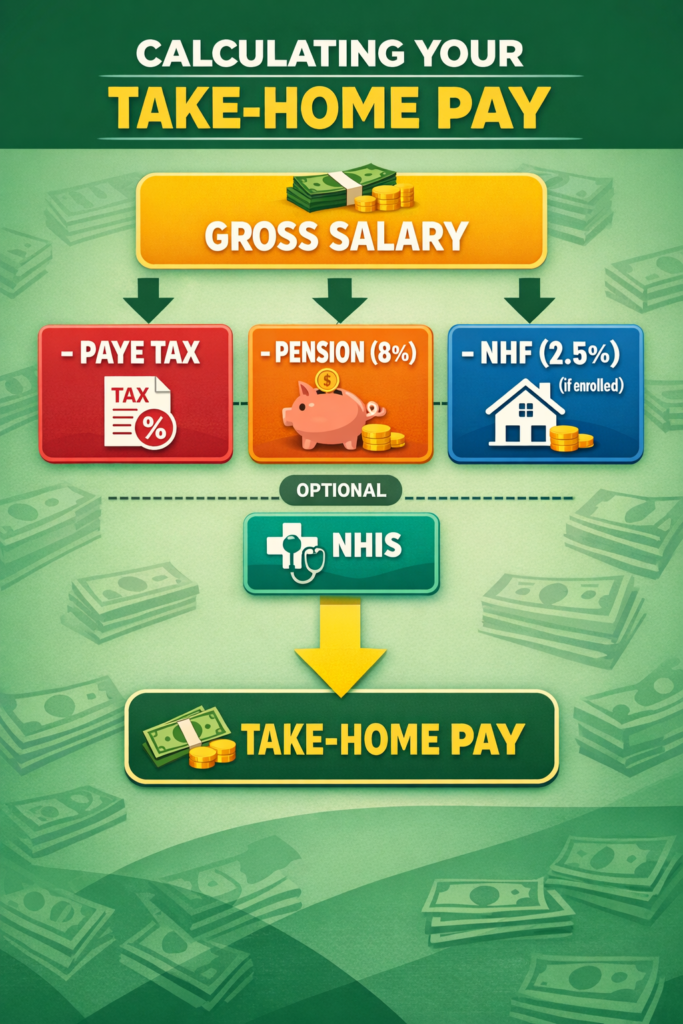
Take-home pay is simple: it is your gross salary minus PAYE tax, minus pension contribution, minus any other statutory deductions like NHF or NHIS. What lands in your account every month is your take-home.
Here is the formula:
Take-Home Pay = Gross Salary – PAYE Tax – Pension (8%) – NHF (2.5% if enrolled) – NHIS (if applicable)
Under the old PITA, your CRA reduced your taxable income before the bands were applied. Under the NTA 2025, the mechanism is different: there is now a flat zero-rate band on the first N800,000 of your chargeable income, plus new deductions like rent relief. The result for most people is a lower tax bill and a higher take-home.
Under the old PITA, your CRA reduced your taxable income before the bands were applied. Under the NTA 2025, the mechanism is different: there is now a zero-rate band on the first ₦800,000 of your chargeable income, plus new deductions like rent relief (20% of annual rent paid, capped at ₦500,000). The result for most people, especially lower and middle earners, is a lower tax bill and a higher take-home.
Not sure what your exact take-home is right now? Use the NairaSeed Tax Calculator to find out your precise figure. Plug in your gross salary and your deductions, and the calculator shows you your net pay monthly and annually.
How Much Extra Are Nigerians Actually Taking Home in 2026?
Actual savings vary significantly depending on your rent, pension, NHF enrolment, and other allowable deductions. Here is a realistic picture across different salary levels (assuming standard 8% pension and moderate rent relief where applicable):
- ₦60,000 – ₦100,000 monthly: Many now pay little or zero PAYE. Extra in pocket: ₦3,000 – ₦7,000+ per month.
- ₦150,000 monthly: Typical monthly PAYE now falls in the ₦6,000 – ₦11,000 range (vs higher under old rules). Extra: often ₦4,000 – ₦9,000 monthly.
- ₦300,000 monthly: Extra usually between ₦5,000 – ₦12,000 monthly.
- ₦500,000+ monthly: Savings are still positive for most, but the percentage benefit becomes smaller as income rises.
The biggest winners in percentage terms are people earning between ₦60,000 and ₦250,000 per month. The new zero-rate band gives them real breathing room.
Note: These are realistic ranges, not exact figures. Your actual savings depend heavily on proof of rent paid and other deductions. The best way to know your real number is to run it through the NairaSeed Tax Calculator.
So You Have Extra Money. What Should You Actually Do With It?
This is where most people go wrong. A small tax saving is easy to lose in daily spending without realising it.
If the extra money is not intentionally redirected, it disappears. That is just how finances work. You feel like you have a bit more breathing room and somehow it is all gone by the end of the month with nothing to show for it.
Here is how to think about your tax saving with real purpose.
Option 1: Build or Top Up Your Emergency Fund Most Nigerians do not have one. An emergency fund is three to six months of your living expenses saved somewhere accessible. If your extra take-home is ₦5,000 or ₦8,000 per month, that is ₦60,000 to ₦96,000 added in a year without feeling it. That is genuinely life-changing for someone living month to month.
Good places to keep it: a high-yield savings account, PiggyVest’s SafeLock, or a money market fund on Cowrywise or Risevest.
Read also: How AI Tools Can Help Nigerians Build an Emergency Fund in 2026 (Even on a Small Salary)
Option 2: Start or Increase Your Investment Contributions If your emergency fund is already sorted, put the tax saving straight into an investment. Even ₦5,000 more per month into a dollar fund, mutual fund, or treasury bill compounds in your favour.
The government effectively gave you a pay rise. The smartest move is to invest it before lifestyle inflation swallows it up. Platforms like Cowrywise, Risevest, Piggyvest, and Bamboo make it easy to start small.
Option 3: Pay Down High-Interest Debt If you have a loan at 20% or above (BNPL, digital loans, credit cards), paying it down faster is one of the best “returns” available. Clear expensive debt first, then redirect the money into savings or investments.
Option 4: Increase Your Pension Contribution Voluntarily You are required to contribute 8%, but you can add more on top. Additional voluntary contributions above the mandatory 8% are tax-deductible under NTA 2025. That means you reduce your taxable income further while saving more for retirement — a double benefit. Talk to your HR or PFA about setting it up.
A Sample Budget Rework for a ₦150,000 Monthly Earner
Let’s make this concrete. Suppose this person now has roughly ₦5,000 – ₦8,000 extra per month after the tax change. Here is one practical way to redeploy it:
| Budget Category | Old Monthly Budget | Suggested New Budget | Change |
|---|---|---|---|
| Rent | ₦75,000 | ₦75,000 | No change |
| Food & Groceries | ₦30,000 | ₦32,000 | +₦2,000 |
| Transport | ₦20,000 | ₦20,000 | No change |
| Utilities & Data | ₦8,000 | ₦8,000 | No change |
| Savings / Investment | ₦5,000 | ₦11,000 – ₦13,000 | +₦6,000 – ₦8,000 |
| Personal / Miscellaneous | ₦12,000 | ₦8,000 | -₦4,000 |
| Emergency Fund Top-Up | ₦0 | ₦4,000 | +₦4,000 |
The total monthly outgoings stay almost the same. But now they are saving and investing significantly more, building an emergency fund, and still eating a bit better, all without earning more money. It just required paying attention.
What If You Are Not Seeing the Extra Money?
Some people are thinking: “I have not noticed any change to my payslip.”
Here are the common reasons:
- Your employer has not updated payroll yet. The NTA 2025 took effect January 1, 2026. Some smaller companies and those using older software were slow to adjust. If your January and February payslips still showed the old PITA deductions, raise it with HR or payroll.
- Your salary sits in a range where the impact is smaller (very high earners above ₦50 million annually may see less benefit or even pay slightly more in some cases).
- Your deductions or salary structure changed alongside the new law.
If you are unsure, use the NairaSeed Tax Calculator to calculate the correct figure, then compare it to your payslip. If there is a gap, that is a conversation to have with your employer.
The Bigger Picture: Why This Moment Matters
Nigeria has not seen a tax overhaul this significant in decades. For millions of salary earners (especially those earning between ₦60,000 and ₦250,000 a month), the NTA 2025 is a genuine financial reset.
A ₦5,000 or ₦8,000 monthly saving does not sound like much in isolation. But that is ₦60,000 to ₦96,000 a year. In three years, consistently redirected and left to grow, it becomes the start of a proper emergency fund, a down payment, or a portfolio that starts working for you.
The tax system gave you a small opening. What you do with it is up to you.
Find out your exact take-home pay in 60 seconds.
Use the NairaSeed Nigerian Tax Calculator to see your 2026 PAYE, your net monthly salary, and a side-by-side comparison with what you paid under the old law. Then come back to this article with your real number and put a plan around it.
Related reading on NairaSeed:
- Nigerian PAYE Tax Calculator 2026: How Much Tax Will You Actually Pay?
- Nigeria’s New Tax Bands Explained: What Every Salary Earner Must Know in 2026
- 6 Legal Deductions That Can Reduce Your PAYE Tax in Nigeria Right Now
Disclaimer Tax figures in this article are estimates based on the Nigeria Tax Act 2025. Individual results vary based on employer structure, actual rent paid (with proof), approved deductions, and state of residence. The budget example is illustrative only. This article does not constitute financial advice. For personalised guidance, speak with a qualified tax or financial professional.