


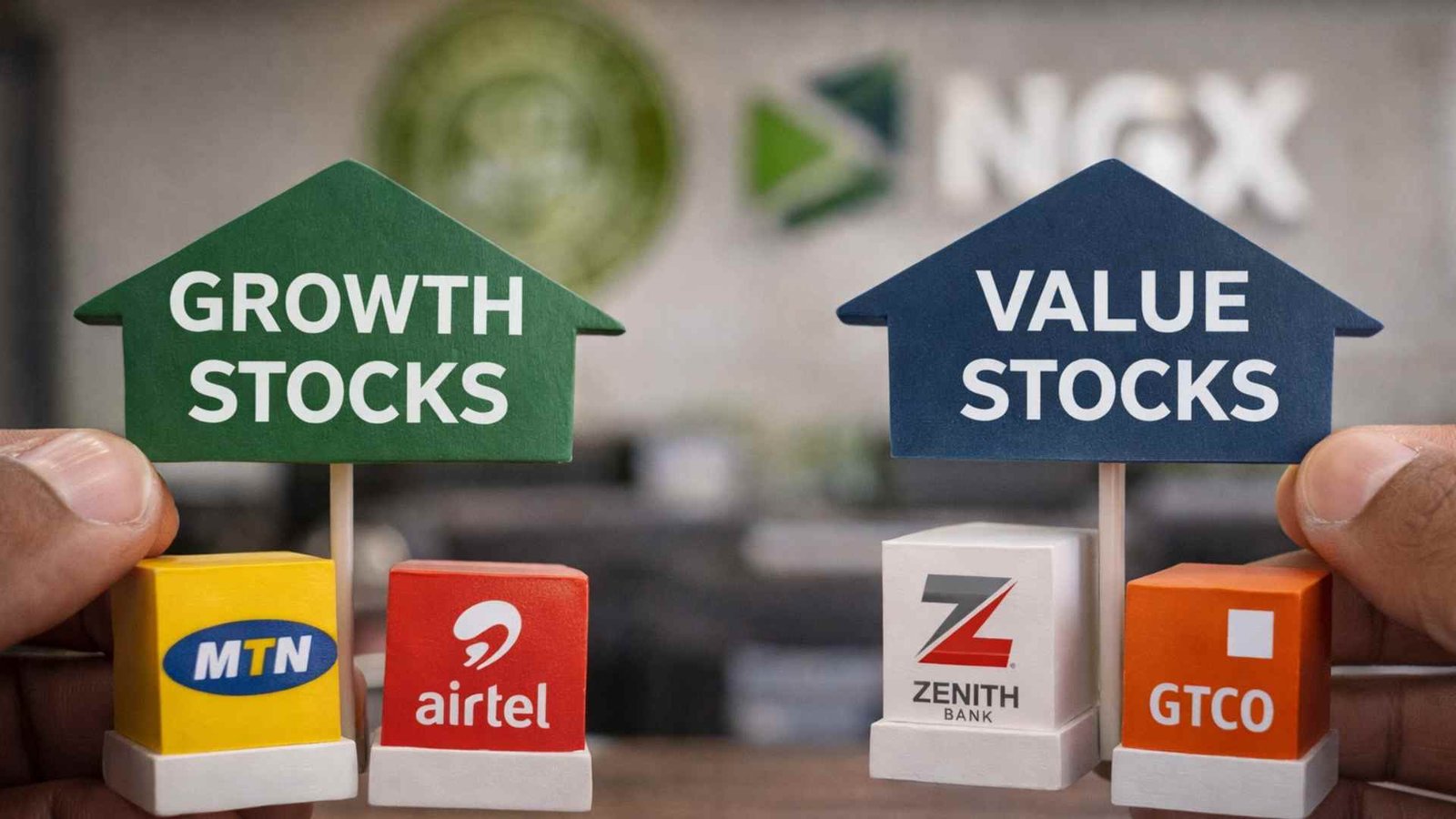
Someone in your WhatsApp investment group says buy GTCO because it’s “undervalued.” Someone else says MTN Nigeria is the future because of data growth. A third person just sends a chart with no explanation.
Everyone has an opinion. Nobody explains the framework.
That framework (the difference between growth stocks and value stocks) is what separates investors who make intentional decisions from those who are just guessing with conviction. This guide breaks it down clearly, with examples from the Nigerian Stock Exchange (NGX), so you can start making smarter calls with your own money.
The Core Idea
Every stock you can buy fits somewhere on a spectrum. On one end are growth stocks — companies expected to expand faster than average, whose share prices reflect future potential more than current earnings. On the other end are value stocks — companies that appear to be trading below what they are actually worth, often because the market has overlooked or temporarily punished them.
Neither is universally better. Both have produced wealth for Nigerian investors. The question is which fits your goals, your timeline, and your risk tolerance right now.
What Are Growth Stocks?
Growth stocks are companies where investors are betting on the future. These businesses are typically expanding revenue quickly, reinvesting profits back into the company rather than paying large dividends, and operating in sectors with strong tailwinds.
Because you are paying for potential, growth stocks often look expensive by traditional valuation metrics. Their price-to-earnings (P/E) ratios tend to be high — sometimes very high. You are not buying what the company earns today. You are buying what you believe it will earn in five or ten years.
On the NGX, examples of companies investors have treated as growth-oriented include:
- MTN Nigeria — data penetration is still growing across Nigeria. As smartphone usage increases and 5G infrastructure expands, MTN’s revenue base grows with it. Investors pay a premium for that trajectory.
- Airtel Africa — similar logic. Pan-African telecoms exposure with mobile money (Airtel Money) as a major growth driver alongside voice and data.
- GTCO (in its fintech pivot) — the Holdco restructuring and HabariPay fintech ambitions position it partly as a technology-growth play within a banking wrapper.
The risk with growth stocks is straightforward: if the growth does not materialise — if data adoption slows, if fintech regulation tightens, if a recession squeezes consumer spending — then you have paid a premium price for a future that did not arrive. The stock can fall sharply.
What Are Value Stocks?
Value stocks are companies that appear to be trading at a discount to what they are genuinely worth. This discount can happen for many reasons — the broader market is selling off, the sector is out of favour, or the company has gone through a rough patch that has spooked investors without fundamentally breaking the business.
Value investors look at metrics like price-to-earnings ratio, price-to-book ratio, and dividend yield to identify these opportunities. The bet is that the market has mispriced the stock and that, over time, the price will correct upward to reflect the company’s true worth.
On the NGX, value-oriented stocks often come from:
- Established banking stocks — Zenith Bank, UBA, Access Holdings have at various points traded at low P/E multiples relative to their earnings, making them attractive to value-oriented investors.
- Consumer goods companies — Nestlé Nigeria and Unilever Nigeria have gone through periods of naira-driven earnings pressure that pushed their valuations down even as their underlying brands remained strong.
- Industrial stocks — companies like Lafarge Africa or WAPCO have occasionally traded at levels that value investors considered deeply discounted relative to book value.
The risk with value stocks is what investors call a value trap — a company that looks cheap but is cheap for a good reason. If earnings keep declining, if the sector is structurally broken, or if management keeps making poor decisions, the stock may stay cheap or get cheaper. Buying it does not guarantee it recovers.
Key Metrics: What to Actually Look At
You do not need to be a financial analyst to apply these concepts. You need to understand a small number of metrics and what they tell you.
Price-to-Earnings Ratio (P/E) This divides the share price by the company’s earnings per share. A high P/E (say, 25x or 30x) suggests the market expects strong future growth — typical of growth stocks. A low P/E (say, 5x or 8x) suggests the stock may be undervalued or that the market has concerns about future earnings — typical of value territory.
On the NGX, average P/E ratios tend to be lower than on major Western exchanges. A P/E of 10x–15x can already indicate a reasonably valued stock in the Nigerian context. Always compare a company’s P/E to others in the same sector, not to global benchmarks.
Price-to-Book Ratio (P/B) This compares the share price to the company’s net assets (assets minus liabilities) per share. A P/B below 1 means you are buying the stock for less than what the company’s books say it’s worth — a classic value signal, though it requires further investigation to understand why.
Dividend Yield Value stocks often pay higher dividends because they are not reinvesting everything into rapid growth. If a stock is paying a 7%–10% dividend yield, that can provide income while you wait for the price to recover. Growth stocks tend to pay little or no dividend.
Revenue Growth Rate For growth stocks, this matters more than current earnings. Is revenue growing consistently, year over year? Is the growth accelerating or slowing? MTN Nigeria’s data revenue growth rate, for example, is a key metric for assessing its growth credentials.
You can find these figures in company annual reports, the NGX website, and platforms like Proshare Nigeria or Nairametrics, which publish NGX financials in readable formats.
How Nigerian Market Conditions Affect This Choice
Investing in Nigeria is not the same as investing in the US or the UK. Several local factors shift how growth and value dynamics play out.
Currency risk changes the value calculation. For companies that earn in naira but have significant dollar costs — like manufacturers importing raw materials — naira devaluation compresses margins and makes “cheap” stocks even more complicated to evaluate. A stock that looks cheap on earnings may have those earnings quietly eroded by FX losses. Always check the FX exposure in a company’s financial notes.
Inflation affects growth stock premiums. In high-inflation environments like Nigeria’s, the present value of future earnings falls. This tends to make growth stocks — which you are buying for distant future earnings — relatively less attractive compared to value stocks that are producing real cash today. This partly explains why Nigerian investors have historically gravitated toward dividend-paying banking stocks.
Liquidity matters on the NGX. The Nigerian Stock Exchange is less liquid than major global markets. Some stocks have thin trading volumes, which means price movements can be exaggerated in both directions. This creates both opportunity and risk for value investors trying to buy into mispriced companies.
Macro cycles hit sectors differently. During periods of high interest rates (like much of 2024–2026), banking stocks benefit from wider margins. During infrastructure booms, construction and cement companies gain. Growth investors need to track not just individual companies but the macro backdrop that drives their sector. Our guide on how to invest in treasury bills in Nigeria touches on the interest rate environment that shapes these decisions.
Which Strategy Has Performed Better on the NGX?
Honest answer: it depends on the period you are measuring and the specific stocks you picked. There is no clean answer that says “value always wins” or “growth always wins” on the Nigerian market.
What the evidence does suggest:
Dividend-paying value stocks have provided reliable compounding returns over the long run for Nigerian retail investors. Banking stocks like Zenith and GTCO have rewarded patient investors with a combination of capital appreciation and consistent dividends — especially those who held through downturns rather than selling in panic.
Growth stocks have delivered spectacular returns in the right windows. MTN Nigeria’s listing in 2019 and its subsequent performance rewarded early investors who correctly identified data growth as a structural trend. Investors who bought into GTCO’s Holdco transition early captured significant upside.
The worst outcomes came from misidentifying value traps. Investors who bought into struggling consumer goods companies expecting a quick recovery sometimes waited years while the business deteriorated further. Cheap is not the same as a bargain.
Practical Framework: How to Choose
Here is a simple decision framework to apply to any NGX stock you are considering:
Ask yourself:
- Is this company growing revenue consistently? If yes, growth framing may apply. If revenue is flat or declining, you are in value territory.
- What is the P/E ratio relative to sector peers? If it is significantly lower with no obvious reason, value opportunity may exist. If it is significantly higher, you are paying a growth premium — make sure the growth is real.
- Does this company pay a dividend? A strong dividend suggests a mature, cash-generating business — typically value. No dividend often signals reinvestment for growth.
- What is the catalyst for a price change? For value stocks, what will make the market reprice this stock upward? For growth stocks, what is the next milestone that justifies the premium?
- What is your timeline? Growth investing typically requires patience measured in years, not months. Value investing can also require patience waiting for the market to recognise what you see. If you need liquidity within 12 months, consider whether the NGX — with its volatility — is the right vehicle at all, or whether instruments like treasury bills are more appropriate for that portion of your money.
Can You Mix Both?
Yes — and most experienced Nigerian investors do.
A common approach is to hold a core of dividend-paying value stocks (banking, industrial) for income and stability, while allocating a smaller portion to growth-oriented positions (telecoms, fintech-adjacent companies) for upside potential.
This is not a rule. It is a starting point. Your allocation should reflect your income situation, your emergency fund status, and how long you can genuinely leave money untouched.
If you are just starting out, one stock is not a portfolio. Diversification across sectors matters more at the beginning than picking the “right” growth or value stock.
The Real Edge: Patience and Research
Whether you lean growth or value, the Nigerian investors who consistently build wealth through the stock market share two traits.
They do their own research — reading annual reports, understanding how the company actually makes money, and not relying solely on WhatsApp tips or social media analysts with no track record.
And they are patient. The NGX is not a place where most retail investors make money through rapid trading. The edge is in buying well-researched positions and giving them time to compound.
Growth vs value is a useful lens. But it is not a shortcut. It is a framework for asking better questions — and better questions lead to better decisions.
Next up: we are publishing a step-by-step guide on how to actually analyze an NGX stock before you buy, numbers, ratios, red flags, and all. Subscribe to the Nairaseed weekly so you don’t miss it. If you want the fuller picture of how to size up any NGX stock before buying, our guide to analyzing Nigerian stocks walks through the full process.