

You need it for a government contract. Or to register property. Or your bank is asking for it. Or a professional body wants it for licence renewal. And you have no idea how to get one or even where to start.
The Tax Clearance Certificate (TCC) is one of those documents that Nigerians only think about when they suddenly need it urgently. And that is exactly the wrong time to start the process, because getting a TCC requires you to have years of clean tax filings behind you.
This post explains what a TCC is, when you need one, what the requirements are, and the step-by-step process for getting yours in 2026.
What Is a Tax Clearance Certificate?
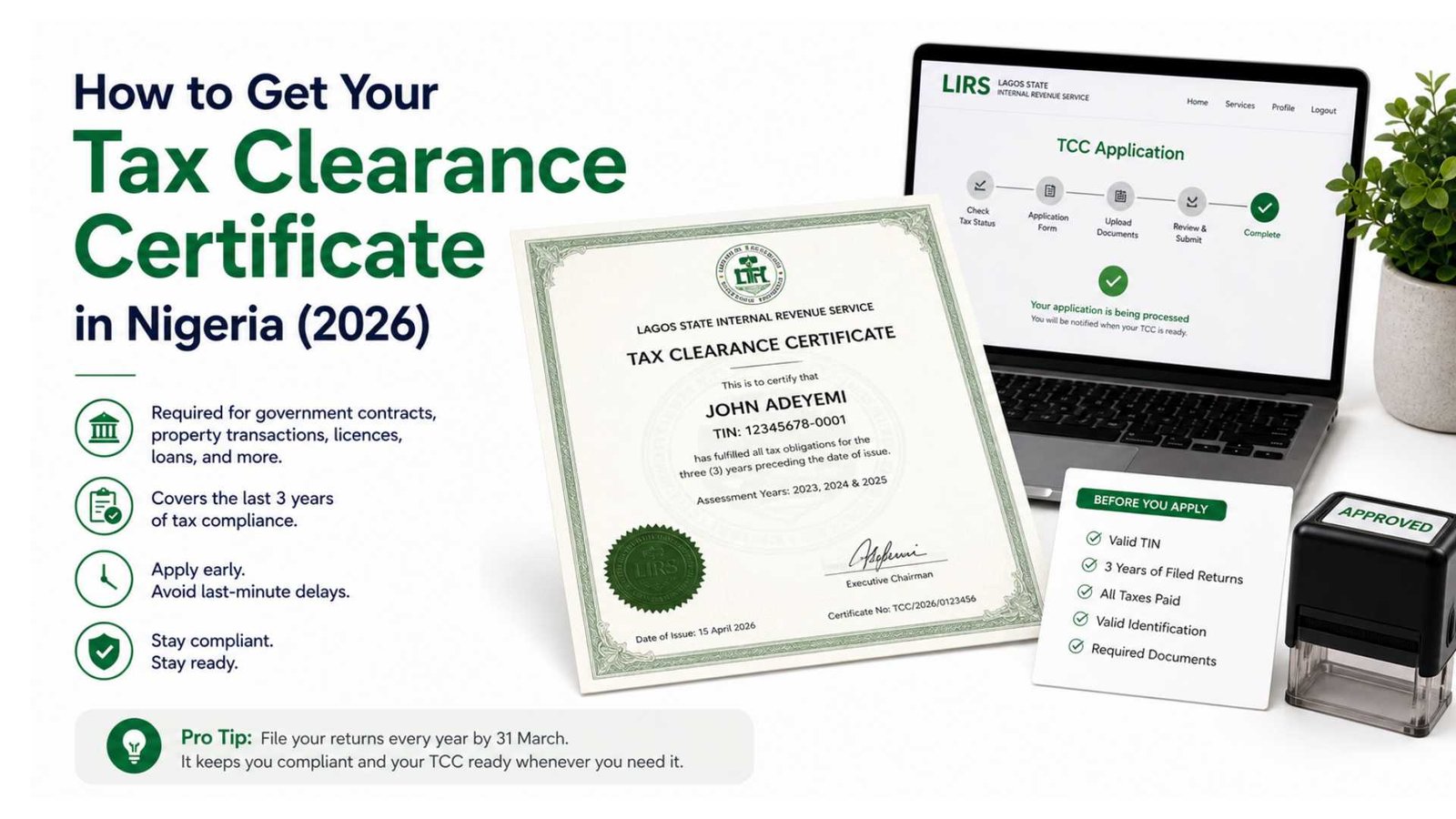
A Tax Clearance Certificate is an official document issued by the State Internal Revenue Service (SIRS) or the Nigeria Revenue Service (NRS, formerly FIRS) that confirms you have paid all your taxes for the three immediately preceding years of assessment.
It is not a certificate that says you are a good person or that you are currently up to date with your taxes. It is specifically a statement covering the last three tax years, confirming that all assessments for those years have been raised, filed, and settled.
A TCC issued in 2026 covers the 2023, 2024, and 2025 tax years. It confirms that your taxes for those three years were filed and paid. It says nothing about your current year compliance.
TCCs are issued at the state level for personal income tax (which is where most salary earners and self-employed individuals interact with the tax system) and at the federal level through the NRS for some categories of taxpayers including companies.
When Do You Actually Need a TCC?
| Situation | Why TCC Is Needed | Issuing Body |
| Government contract or tender | Mandatory for all government procurement | State IRS / FIRS |
| Property purchase or sale | Required for land title documentation at many states | State IRS |
| Import / export licence | Customs and NRS require evidence of tax compliance | NRS / FIRS |
| Professional licence renewal | Law, medicine, engineering bodies often require TCC | State IRS |
| Travelling on government scholarship or official duty | Federal government often requires TCC for foreign travel approvals | FIRS / NRS |
| Taking a bank loan above certain thresholds | Some banks require TCC for high-value loan applications | State IRS |
| Registering a company or changing directorship | CAC may require TCC for certain registrations | FIRS / NRS |
The most common trigger for most NairaSeed readers is either a government-related contract or procurement process, a property transaction, or a professional licence renewal. If you work in any regulated sector or plan to do any business with government, keeping your TCC current is not optional.
The Two Things You Need Before Anything Else
1. A valid TIN
Your Tax Identification Number is the foundation. Without one, you cannot file returns and you cannot get a TCC. If you do not have a TIN, get one first. You can register online through the NRS TaxPro Max portal (taxpromax.gov.ng) or visit your State IRS in person. You will need your BVN, a valid ID, and your personal details. The process is free.
2. Three years of filed income tax returns
A TCC covers your last three years of assessment. That means you must have filed returns for all three of those years. If you have not been filing, you will need to catch up before your TCC application can be processed.
For PAYE employees whose employer has been correctly deducting and remitting PAYE, the filing obligation is technically satisfied for employment income. But if you had any other income during those years and did not declare it, you will need to file amended or supplementary returns.
For self-employed individuals and anyone with income outside PAYE, you need three years of direct assessment returns on record before a TCC can be issued.
What Documents Do You Need to Apply?
| Document | Purpose | Required? |
| Valid TIN | Uniquely identifies you in the tax system | Yes, always |
| Completed TCC application form | Formal request for the certificate | Yes |
| Evidence of filed returns (3 years) | TCC covers the 3 preceding tax years | Yes |
| Proof of PAYE remittance or direct tax payment | Confirms taxes were actually paid, not just assessed | Yes |
| Valid means of identification | National ID, driver’s licence, international passport, or voter’s card | Yes |
| Employer letter (for PAYE employees) | Confirms employment status and salary range | Often required |
| Business registration documents (for business owners) | CAC certificate and any relevant business licences | For self-employed |
The employer letter is worth flagging. Not all State IRS offices require it, but many do for PAYE employees, particularly if your employer is well known and has been remitting PAYE on your behalf. The letter should be on company letterhead, signed by HR or finance, and confirm your name, staff ID, annual gross salary, and that PAYE has been deducted and remitted to the State IRS.
The Step-by-Step Process
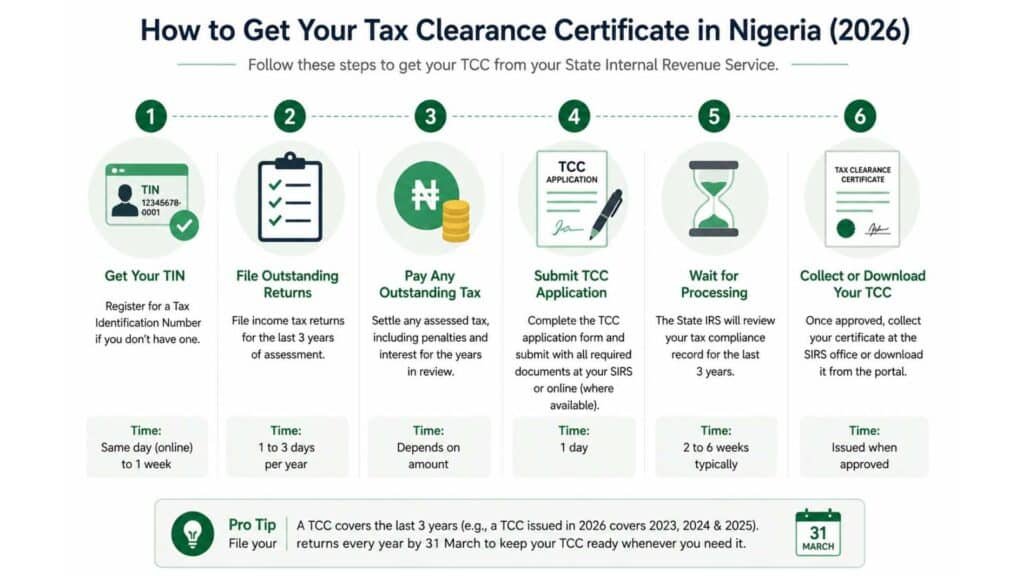
| Step | Action | Typical Time |
| 1. Get your TIN | Register online or at your State IRS if you do not have one | Same day (online) to 1 week |
| 2. File outstanding returns | File 3 years of income tax returns if not already done | 1 to 3 days per year |
| 3. Pay any outstanding tax | Settle any tax assessed for those years plus any penalties | Depends on amount |
| 4. Submit TCC application | Complete form and submit with all documents at State IRS or online | 1 day |
| 5. Wait for processing | State IRS reviews your compliance record across 3 years | 2 to 6 weeks typically |
| 6. Collect or download TCC | Physical collection at SIRS or download from portal | Issued when approved |
The step that trips most people up is step 2: having three years of filed returns. If you have never filed before and suddenly need a TCC in a hurry, you are looking at potentially filing three years of back returns before the application can even be considered. This is why starting early matters.
Do not wait until you need a TCC to start filing your returns. File every year by 31 March, even if you do not think you owe anything extra. It costs nothing, takes a few hours, and it means your TCC is always available when you need it.
How Long Does It Take?
Processing times vary by state and by how busy the SIRS is at the time you apply. In Lagos (LIRS), the online process through the LIRS portal can sometimes produce a TCC within two to three weeks if everything is in order. In other states, it can take four to six weeks or longer.
Practical tip: apply well ahead of when you actually need the TCC. If you know you are bidding for a contract that closes in six weeks, apply now. Do not apply the week before.
Some states offer expedited processing for an additional fee. This is at the discretion of the SIRS and is not standardised. Ask at your local office if timeline is critical.
What If You Have Outstanding Tax to Pay?
The SIRS will not issue a TCC if you have outstanding tax liabilities. Before your application is approved, any assessed tax for the three years covered, including penalties and interest for late filing, must be fully paid.
If you discover you owe back taxes when you start this process, the options are to pay the full amount, or to negotiate a payment plan with the SIRS. Some states allow instalment arrangements for taxpayers in good faith. The TCC will not be issued until the arrangement is in place and initial payments have been made.
Do not try to get a TCC without settling outstanding liabilities. The system checks across your filing and payment history before issuing.
State-Specific Notes
Lagos (LIRS)
Lagos has the most advanced digital infrastructure for tax administration in Nigeria. You can apply for a TCC entirely online through the LIRS portal (lirs.gov.ng). The portal shows your filing history, outstanding liabilities, and lets you submit your application and track its status digitally.
Abuja / FCT (AFCIRS)
The Abuja Federal Capital Territory Internal Revenue Service (AFCIRS) handles personal income tax for FCT residents. Applications can be made in person or increasingly online. Wait times are typically two to four weeks.
Other states
Most other state IRS offices still process TCC applications primarily in person. Bring all your documents in hard copy. Some states have begun digitising their processes but adoption varies significantly. When in doubt, visit the SIRS office in your state capital and ask for the assessment or compliance desk.
Make sure your tax figures are accurate before you file.
Use the NairaSeed Tax Calculator to confirm your correct PAYE before you file your annual return. Knowing your accurate liability makes the filing process faster and helps you avoid paying too much or too little.
>> Calculate your tax before you file
Related reading on NairaSeed:
- How to File Your Annual Income Tax Return in Nigeria (2026)
- PAYE Tax in Nigeria: A Complete Guide for Employees and Employers (2026)
- Nigerian PAYE Tax Calculator 2026: How Much Tax Will You Actually Pay?
- 6 Legal Deductions That Can Reduce Your PAYE Tax in Nigeria Right Now
Disclaimer
Tax clearance certificate processes vary by state and may change. Processing times, required documents, and portal availability depend on your State IRS. This article is based on general practice as of April 2026 and is for educational purposes only. It does not constitute legal or tax advice. For specific guidance, contact your State Internal Revenue Service directly or consult a qualified tax professional.