


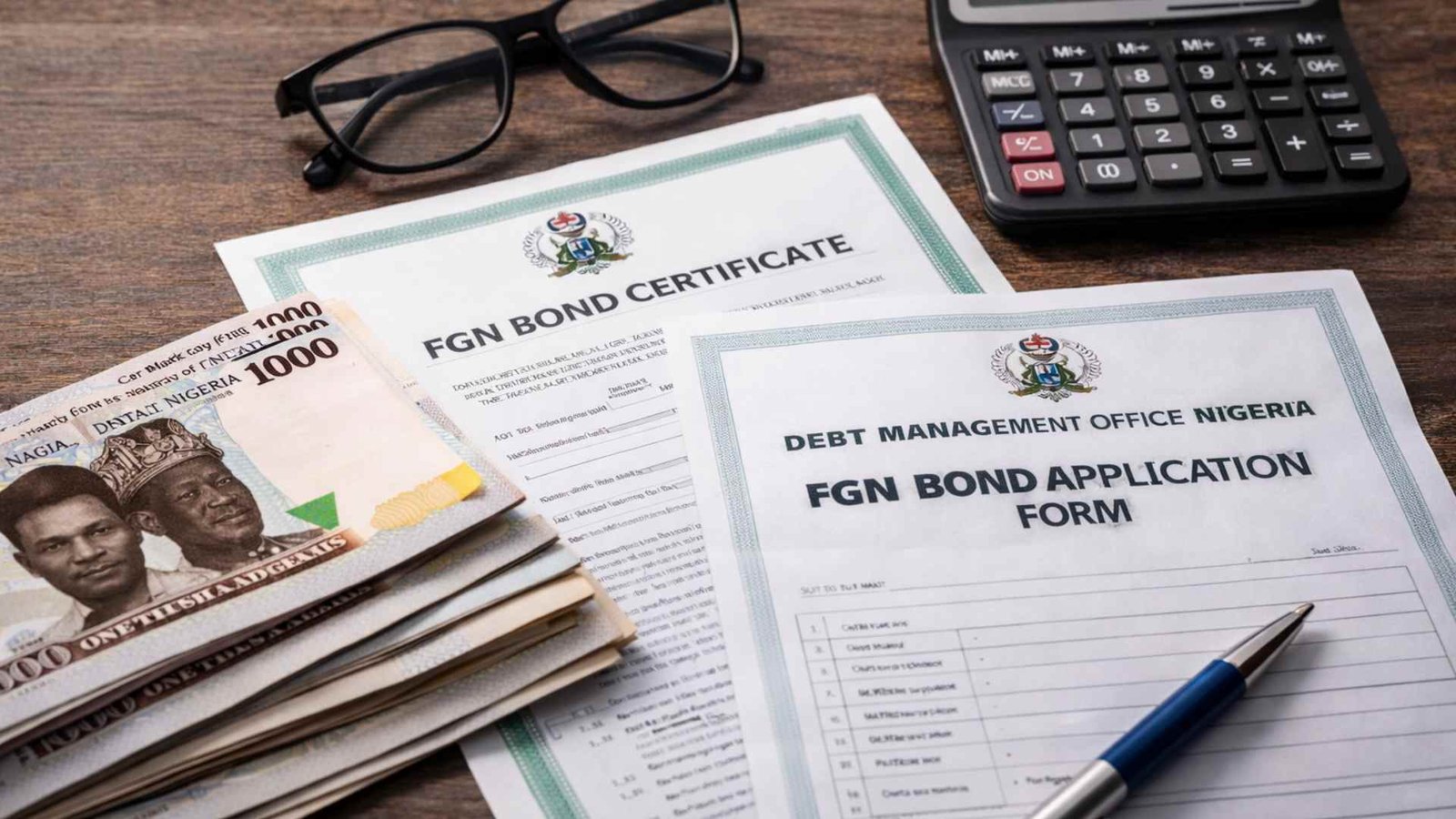
Most Nigerians who are building wealth seriously have heard of FGN Bonds. Few have actually bought one. The gap between awareness and action usually comes down to the same three things: (1) confusion about how they work, (2) uncertainty about where to buy them, and (3) a nagging feeling that bonds are “for big investors” or “too complicated.”
None of those things are true. This guide clears all of it up.
By the end, you will understand exactly what Nigerian government bonds are, how they differ from other fixed income options, what they currently pay, and whether they make sense for where you are financially right now.
What Is an FGN Bond?
A Federal Government of Nigeria (FGN) Bond is a debt instrument issued by the Nigerian federal government and managed by the Debt Management Office (DMO). When you buy one, you are lending money to the government for a fixed period, typically between 2 and 30 years. In return, the government pays you a fixed interest rate (called the coupon rate) every six months, and returns your principal in full when the bond matures.

Unlike treasury bills, which are short-term instruments lasting 91 to 364 days, bonds are long-term commitments. That longer timeline is the central trade-off, you get a higher and more predictable income stream, but your money is committed for much longer.
The Nigerian government has never defaulted on an FGN Bond. They are backed by the full faith of the federal government and guaranteed by the DMO. In terms of credit risk, they sit at the top of the Nigerian investment pyramid.
How FGN Bonds Work: The Mechanics
Here is the flow in plain terms:
The DMO auctions bonds regularly, typically every month. Bonds are issued with a face value (usually ₦1,000 per unit, with a minimum purchase of 1,000 units, making the minimum ₦1,000,000 at primary market level). The bond carries a coupon rate, a fixed annual interest rate applied to the face value. That coupon is paid to you in two instalments every year until maturity.
Example: You buy ₦2,000,000 worth of a 10-year FGN Bond at a 15% coupon rate.
Every six months, you receive: ₦2,000,000 × 15% ÷ 2 = ₦150,000
Over ten years, that is ₦3,000,000 in coupon payments alone, and that’s before you even get your ₦2,000,000 principal back at maturity. Total received: ₦5,000,000 on a ₦2,000,000 investment.
That is the fundamental power of bonds for long-term wealth building.
Types of FGN Bonds Available in Nigeria
Not all government bonds are the same. Here is what is currently available:
Standard FGN Bonds The most common type. Fixed coupon, fixed maturity. Issued in tenors ranging from 2 years to 30 years. These are what most retail investors buy.
FGN Savings Bond This is the DMO’s product specifically designed for retail investors (everyday Nigerians, not institutions). It has a much lower minimum investment (as low as ₦5,000), is issued in 2-year and 3-year tenors, and is bought directly through stockbrokers or online via the DMO’s platform. Coupon payments are made quarterly rather than semi-annually, which some investors prefer for regular cash flow.
Sukuk Bonds Nigeria also issues Sukuk bonds, which are structured to comply with Islamic finance principles; no fixed interest, but profit-sharing returns. These have been used to fund specific infrastructure projects. They appeal to Muslim investors and those who simply want an alternative structure.
Green Bonds Nigeria has issued Green Bonds to fund environmentally focused projects. Returns are similar to standard FGN Bonds but the proceeds go toward specific climate or sustainability projects.
For most beginners, the FGN Savings Bond is the most accessible entry point, and the standard FGN Bond is what to graduate to as your investable capital grows.
What Do FGN Bonds Currently Pay?
As of early 2026, FGN Bond coupon rates vary by tenor:
- 2-year bonds: approximately 14%–16% per annum
- 5-year bonds: approximately 16%–18% per annum
- 10-year bonds: approximately 18%–20% per annum
- 30-year bonds: approximately 19%–22% per annum
These are fixed rates set at the time of issuance. Unlike treasury bills, which reset at each new auction, your bond coupon does not change after you buy. If you lock in a 20% coupon on a 10-year bond today, you earn 20% per annum on that bond for the full ten years, and that’s regardless of where rates go afterwards.
This is a significant feature. If interest rates fall in the future (as they likely will as inflation is brought under control), your locked-in rate becomes even more valuable compared to what new investors can get.
FGN Bonds vs Treasury Bills: Which Is Better?
This is one of the most common questions Nigerian investors ask, and the honest answer is: they serve different purposes.
| Feature | Treasury Bills | FGN Bonds |
|---|---|---|
| Tenor | 91, 182, 364 days | 2 to 30 years |
| Returns (2026) | 18%–22% | 14%–22% depending on tenor |
| Minimum investment | ₦50,000 (via bank) | ₦5,000 (FGN Savings Bond) |
| Payment frequency | At maturity (discount upfront) | Semi-annually or quarterly |
| Rate certainty | Changes each auction | Fixed at purchase |
| Best for | Short-term parking of cash | Long-term income and wealth building |
If you are managing money you might need within the next year, short-term fixed income instruments are more appropriate. If you are building a wealth foundation you will not touch for five, ten, or twenty years, bonds become seriously compelling.
Many experienced Nigerian investors hold both: T-Bills for liquidity management and bonds for long-term compounding.
How to Buy FGN Bonds in Nigeria
There are three main routes.
Route 1: The DMO FGN Savings Bond (easiest for beginners)
The DMO opens subscriptions for FGN Savings Bonds once a month, for a five-day window. You buy through a licensed stockbroker or selected banks. The DMO publishes the subscription dates and rates on its website (dmo.gov.ng). Minimum is ₦5,000, with additional purchases in multiples of ₦1,000 after that.
Steps:
- Open a stockbroking account with any SEC-registered stockbroker (Stanbic IBTC Stockbrokers, Chapel Hill Denham, Vetiva, ARM Securities, and others).
- Fund your stockbroking account.
- During the monthly subscription window, instruct your broker to purchase the FGN Savings Bond on your behalf.
- Your bond units are credited to your CSCS account (the central securities clearing system that holds your investments).
- Coupon payments hit your nominated account quarterly.
Route 2: Primary Market Auction (for larger amounts)
For standard FGN Bonds above the Savings Bond threshold, you participate through the monthly DMO auction via a primary dealer — which is a bank or stockbroker with direct CBN authorisation. The minimum here is ₦1,000,000. Your bank’s investment desk or a full-service stockbroker handles the process.
Route 3: Secondary Market (buying existing bonds)
You do not have to wait for a new issuance. Existing bonds trade on the FMDQ Exchange (for institutional-size trades) and through stockbrokers for retail investors. Buying in the secondary market means you are purchasing from someone who wants to exit before maturity. The price may be above or below face value depending on how current interest rates compare to the bond’s coupon rate.
This is slightly more complex and better suited to investors who already understand how bond pricing works.
How Bond Pricing Works (The Part Most People Skip)
This matters if you ever want to sell before maturity or buy in the secondary market.
Bond prices and interest rates move in opposite directions. When new interest rates in the market go up, existing bonds with lower coupons become less attractive, so their price falls. When rates go down, your existing bond with a higher coupon becomes more valuable, so its price rises.
Example: You bought a bond at 18% coupon. Rates in the market drop to 14%. Your bond, which still pays 18%, is now worth more than face value. If you sell it, you collect a capital gain on top of your coupon income.
The reverse is also true. If you need to sell when rates have risen above your coupon rate, you may get less than face value.
This is why bonds held to maturity are simpler to think about. You always get your principal back at face value on maturity day, regardless of what happened to market rates in between. The price volatility only matters if you sell early.
Tax Treatment of FGN Bonds
FGN Bond coupon income is exempt from income tax for individual investors in Nigeria. This is a statutory exemption under the Companies Income Tax Act and is one of the most overlooked advantages of government bonds compared to other investment options.
Treasury bill returns attract 10% withholding tax. Bank interest attracts 10% WHT. FGN Bond coupons, for individuals, are tax-free.
On a 20% coupon rate, that tax exemption is meaningful. It makes the effective return on bonds higher than a similar gross return on a taxable instrument.
Who Should Consider FGN Bonds?
Bonds are not for everyone at every stage. Here is a straightforward guide:
Bonds likely make sense if:
- You have a stable income and surplus funds you will not need for two or more years
- You want predictable, regular income (the semi-annual or quarterly coupon payments)
- You are building retirement savings or a long-term wealth foundation
- You want to lock in today’s high rates before they potentially fall
- You are already comfortable with basic investing concepts and platforms and want to move beyond savings accounts
Bonds are probably not the right first move if:
- You do not yet have an emergency fund covering three to six months of expenses
- Your investment horizon is less than two years
- You are likely to need the money at short notice — bonds are illiquid unless you sell on the secondary market
- You have high-interest debt that you have not yet addressed
The sequencing matters. Bonds reward investors who have already built financial stability underneath them. They are not a substitute for an emergency fund or a solution to short-term cash flow problems.
The Bigger Picture: Where Bonds Fit in a Nigerian Wealth Portfolio
Think of a well-structured Nigerian investment portfolio in layers:
Foundation layer — emergency fund in a high-yield savings account or money market fund. Liquid, accessible, earning something.
Stability layer — government-backed fixed income covering short to medium-term financial goals. T-Bills for 3–12 months, FGN Bonds for 2 years and beyond.
Growth layer — equity investments through the NGX, where understanding the difference between growth and value stocks helps you pick positions intentionally rather than blindly.
Opportunistic layer — dollar-denominated assets, real estate, or alternative investments for investors with surplus capital and higher risk tolerance.
FGN Bonds belong firmly in the stability layer — and for many Nigerian investors building serious long-term wealth, they deserve a larger allocation than most people currently give them.
The Bottom Line
FGN Bonds are one of the most underused wealth tools available to Nigerian retail investors. They offer government-backed security, tax-free coupon income, predictable cash flow, and the opportunity to lock in high rates for years at a time.
They are not complicated. They are not just for big investors. And in a market environment where inflation has been punishing idle savings, they are one of the clearest answers available to the question: where do I put my money so it actually grows?
The DMO’s Savings Bond in particular, with a ₦5,000 entry point, removes every excuse to wait.
The Nairaseed Weekly lands every Friday with investing guides, personal finance breakdowns, and honest money analysis for Nigerians at home and abroad. Subscribe free below. If you want the fuller picture of how to size up any NGX stock before buying, our guide to analyzing Nigerian stocks walks through the full process.