

You have probably heard someone mention treasury bills and nodded like you understood. Most Nigerians do. Then they go home, search it once, get confused by CBN jargon, and just leave their money in a savings account earning 4% while inflation eats the rest.
This guide fixes that. By the end of it, you will know exactly what Nigerian treasury bills are, what they currently pay, who can buy them, and the step-by-step process for getting started, even if you have ₦50,000 to invest or ₦5 million. No jargon and no filler.
What Are Treasury Bills, Really?
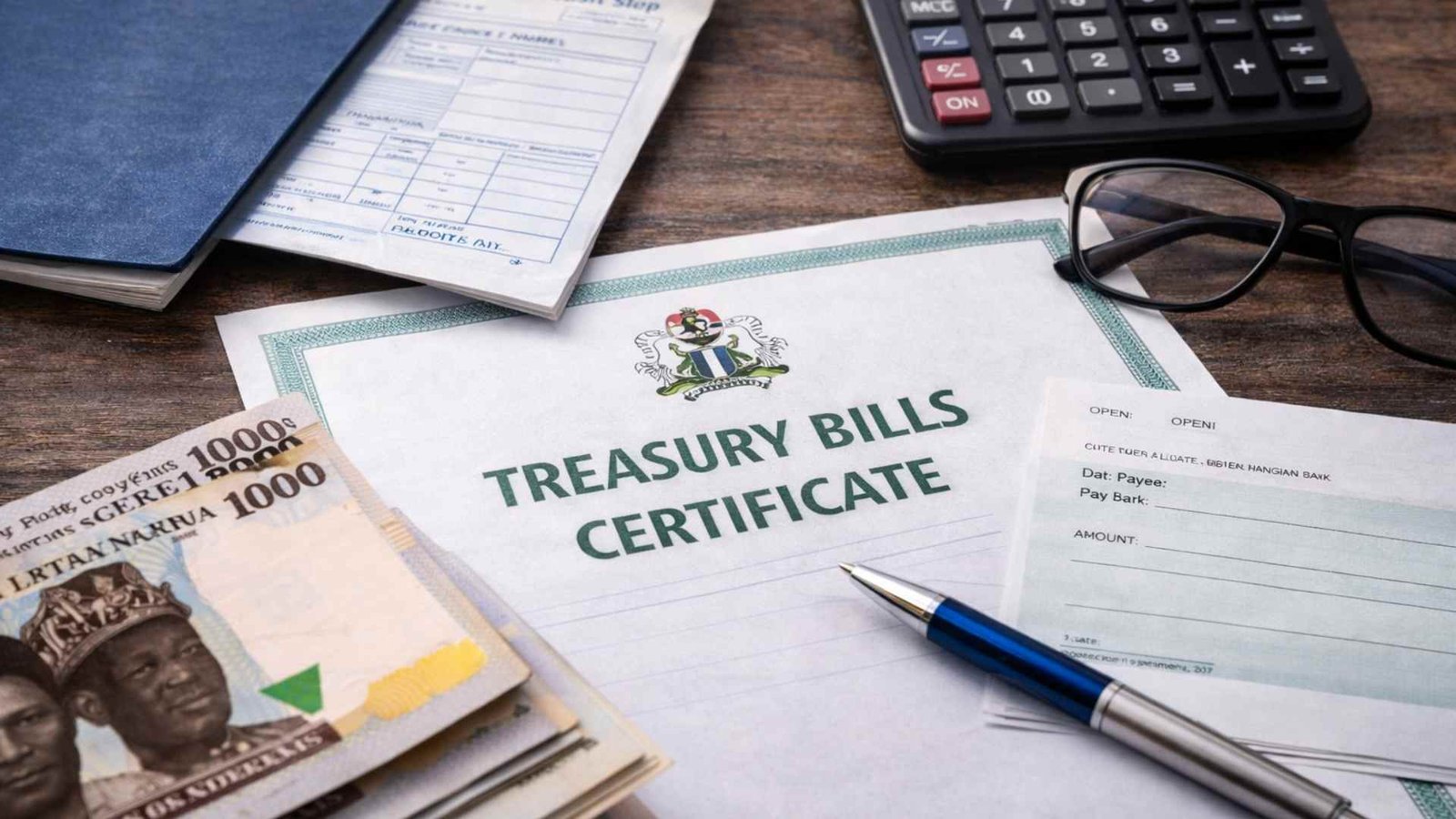
A treasury bill (T-Bill) is essentially a short-term loan you give to the Nigerian federal government. The government needs money to fund its operations between tax collection periods, so it borrows from the public. You lend. They pay you back with interest after a fixed period.
That’s it. That’s the whole product.
The Central Bank of Nigeria (CBN) manages the process on behalf of the federal government. T-Bills are issued at a discount, meaning you pay slightly less than the face value, and at maturity, you receive the full face value. The difference is your return.
For example: you buy a ₦1,000,000 T-Bill at a discount and only pay ₦820,000. At maturity, you collect ₦1,000,000. Your profit is ₦180,000. That is your yield.
Why Do Nigerians Use T-Bills?
Three reasons stands out.
Safety. Treasury bills are backed by the federal government. In the Nigerian context, that means the CBN guarantees repayment. They have never defaulted on a T-Bill. While no investment is technically 100% risk-free, T-Bills are as close as it gets in this country.
Returns that actually beat savings accounts. As of early 2026, T-Bill stop rates, the effective interest rate, have ranged between 18% and 22% depending on the tenor and auction date. Compare that to the 4%–10% most Nigerian savings accounts offer, and the gap is stark.
Flexibility of tenors. You are not locking your money away for years. Nigerian T-Bills come in three tenors: 91 days (about 3 months), 182 days (about 6 months), and 364 days (one year). You pick the timeline that works for your situation.
Who Can Buy Treasury Bills in Nigeria?
Anyone. Individual Nigerians, Nigerians in the diaspora, corporates, and even foreigners can invest in Nigerian T-Bills. There is no requirement to be a finance professional, a high-net-worth investor, or anything else. If you have the minimum amount and a bank account, you can participate.
The two routes available to most regular Nigerians are:
1. Primary market — buying directly at CBN auctions through your bank.
2. Secondary market — buying from other investors who want to sell before their T-Bill matures, usually through your bank or a stockbroker.
Most beginners use the primary market through their bank. The secondary market gives you more flexibility but usually comes with slightly different pricing.
What Is the Minimum Amount to Invest?
The CBN sets the minimum at ₦50,000,000 for direct primary market participation, which immediately rules out most individual investors.
But don’t stop reading. This is where your bank comes in.
Banks aggregate funds from multiple retail investors and bid on your behalf. Most banks have their own retail T-Bill offerings with much lower minimums, typically ₦10,000 to ₦100,000 depending on the bank. Some fintech platforms have brought it down even further.
Here is the landscape in 2026:
- Stanbic IBTC, Zenith, GTBank, Access — retail T-Bill desks with ₦50,000 to ₦100,000 minimums
- Cowrywise — offers T-Bills via its fixed income product with lower entry points
- Risevest — dollar T-Bills and similar instruments for those looking at foreign-currency options
- ARM Investment — one of the more established asset managers for fixed income in Nigeria
If you have less than ₦100,000 to start with, a fintech platform or money market fund (which invests heavily in T-Bills) may be a more practical entry point.
Step-by-Step: How to Buy Treasury Bills Through Your Bank
Here is the most common route for individual Nigerian investors in 2026.
Step 1: Confirm your bank offers retail T-Bill investment
Not every branch does this well. Visit your bank’s website or call their investment banking or treasury desk. Ask specifically: “Do you offer treasury bill investments for individual customers, and what is the minimum?”
GTBank, Stanbic IBTC, Zenith, FCMB, and Access Bank all have structured retail T-Bill offerings. Some allow you to do this entirely through internet banking or their mobile app.
Step 2: Complete the KYC requirements
If you already have an account in good standing, your Know Your Customer (KYC) documentation is likely already on file. Some banks require a separate mandate form or investment account to be opened before you can buy T-Bills. Ask what paperwork is needed and handle it before the next auction date.
Step 3: Find out the next CBN auction date
The CBN conducts T-Bill auctions every two weeks (bi-weekly). Your bank will know the schedule. The CBN also publishes the upcoming auction calendar on its website at cbn.gov.ng. For retail investors going through a bank, you typically need to submit your funds a few days before the auction.
Step 4: Submit your investment instruction
Tell your bank: how much you want to invest, and which tenor (91, 182, or 364 days). They will place your bid at the auction and notify you of the stop rate — the actual yield you received. You do not get to choose the rate; it is determined by market forces at the auction.
Step 5: Funds are deducted and T-Bill is issued
On auction day, your bank deducts your investment amount from your account and your T-Bill is issued. You will typically see a credit advice or a T-Bill certificate. With most banks, you can view this in your online banking portal under “investments.”
Step 6: Wait for maturity — or sell early if needed
On maturity date, your principal plus interest is automatically credited back to your account. If you need the money earlier, you can sell your T-Bill in the secondary market through your bank — though this may affect your yield depending on prevailing market rates.
How to Buy T-Bills Through Fintech Platforms
If the bank route feels heavy, fintech platforms simplify the process considerably.
Cowrywise has a “Fixed Returns” product that pools funds into T-Bills and similar government securities. You set your amount, choose a lock-in period, and earn a fixed rate. The process takes about 5 minutes on the app.
ARM Investment allows retail investors to access money market and fixed income funds with T-Bill exposure through their app with minimums starting around ₦5,000.
The tradeoff with platforms is that you are investing in a fund that holds T-Bills, not directly owning a T-Bill yourself. The returns are similar but not identical, and there is an additional layer of fund management fees (usually small but worth checking).
For most people starting out, the platform route is fine. For larger amounts — say ₦500,000 and above — going through your bank’s treasury desk gives you more control and slightly better rates.
What Returns Can You Realistically Expect in 2026?
T-Bill rates in Nigeria move with the CBN’s Monetary Policy Rate (MPR) and the broader interest rate environment. Here is where things stand in 2026:
- 91-day T-Bills: approximately 18%–20% per annum
- 182-day T-Bills: approximately 19%–21% per annum
- 364-day T-Bills: approximately 20%–22% per annum
These are annualised rates. Your actual payout is proportional to how long your money is locked in.
A practical example:
You invest ₦500,000 in a 364-day T-Bill at a 21% discount rate. Your discount is calculated on the face value, so you receive interest upfront (since T-Bills are priced at a discount). At maturity, you collect your ₦500,000 face value, meaning your effective return is roughly ₦105,000 over the year.
That is significantly more than the ₦25,000–₦40,000 most savings accounts would earn on the same amount.
Important caveat: T-Bill rates are not fixed forever. They change with each auction. If you roll over a T-Bill after it matures, the rate on your next bill may be higher or lower depending on the market at that time.
Are T-Bills Taxed in Nigeria?
Yes. Withholding Tax (WHT) of 10% applies to investment income from T-Bills for individual investors. Your bank or platform deducts this automatically before paying your returns. This is not something you have to chase. It is handled for you.
So if your gross yield is ₦100,000, you receive ₦90,000 after WHT. When comparing T-Bill returns to other investments, always use the net-of-tax figure.
T-Bills vs Other Low-Risk Options: A Quick Comparison
| Investment | Typical Rate (2026) | Risk | Liquidity | Tax |
|---|---|---|---|---|
| Savings account | 4%–10% | Very low | Instant | WHT applies |
| Treasury bills | 18%–22% | Very low | Low (until maturity) | 10% WHT |
| FGN Bonds | 14%–19% | Very low | Low (long tenor) | WHT applies |
| Money market fund | 16%–20% | Low | Moderate | WHT applies |
| Fixed deposit | 10%–17% | Low | Low (penalty for early exit) | 10% WHT |
T-Bills sit in the sweet spot: government-backed safety, rates that genuinely beat inflation in some periods, and relatively short tenors that keep your money from being locked away for years.
Honest Limitations to Know Before You Start
Your money is locked. Once you buy a T-Bill, you cannot simply withdraw it like a savings account. You can sell in the secondary market, but that adds friction and may affect your returns. Only invest money you genuinely will not need for the duration of the tenor.
Rates can change. The 21% you see today may be 17% when you roll over in six months. T-Bills are not a set-and-forget vehicle — you need to check current rates before reinvesting.
Inflation is the real competition. Nigeria’s official inflation rate as of early 2026 sits around 15%. A 21% T-Bill return still gives you a positive real return — but in periods of very high inflation, that gap shrinks. Understand what you are earning in real terms, not just nominal terms.
Bank fees. Some banks charge a management or placement fee for retail T-Bill investments. These are usually small (0.5%–1%) but ask upfront so there are no surprises.
A Good Starting Point
If you have never invested before and you want somewhere safe to start while you learn — treasury bills are one of the most sensible answers in Nigeria’s current environment. They are not exciting. They will not make you rich overnight. But they will reliably grow your money faster than any savings account, with government backing, and on a timeline short enough that you are not making a decade-long commitment.
Start with one 91-day cycle. See how your bank handles it. Understand the process. Then scale up if it makes sense for your financial goals.
That first cycle is worth more than another month of reading about it.
Have a question about T-Bills that this guide did not answer? Drop it in the comments or reach the Nairaseed team at editorial@nairaseed.com.
Related posts If you want the fuller picture of how to size up any NGX stock before buying, our guide to analyzing Nigerian stocks walks through the full process.
- Beginner’s Guide to Investing in Nigeria Without Losing Sleep
- Dollar vs Naira Savings: Where Should Nigerians Keep Their Money in 2026?
- PiggyVest vs Cowrywise vs Risevest – Which is Best should you be using in 2026
Related reading: If you’re weighing where to actually put your money, see Money Market Funds vs Treasury Bills: Where Should You Keep ₦500,000 in Nigeria?.
Try it yourself: use the Money Market Fund vs Treasury Bill Calculator to run this with your own numbers.