


Your January 2026 payslip probably looked a little different. Maybe you got a bit more. Maybe you are not sure why. Either way, the Nigeria Tax Act (NTA) 2025 is now live, and it has completely changed how your PAYE is calculated.
This post breaks down exactly how the new system works, what it means for your salary, and how to use the NairaSeed Nigerian PAYE Tax Calculator to find out your exact tax figure in under 60 seconds.
No jargon. No guesswork. Just real numbers.
First: What Changed with PAYE in 2026?
Before the NTA 2025, your employer calculated your tax using the old Personal Income Tax Act (PITA) bands. Those started taxing you from your very first naira of income, after applying the Consolidated Relief Allowance (CRA).
The NTA 2025 threw that system out and replaced it with something simpler and, for most Nigerians, more generous. Here is what is different now:
- The tax-free band is now N800,000 per year. Under the old law, you got taxed from N300,000. Now the first N800,000 of your chargeable income attracts zero tax. If you earn N66,666 or less per month after deductions, you pay nothing.
- The CRA is gone. The old Consolidated Relief Allowance (a fixed N200,000 plus 20% of gross income) has been scrapped. In its place is a Rent Relief system that lets you deduct 20% of your actual annual rent, capped at N500,000.
- New tax bands apply from N800,000 upward. The rate structure is completely new, running from 15% up to 25% depending on your income level.
- The 1% minimum tax rule no longer applies. The NTA 2025 abolished the old minimum tax provision for individuals. You only pay what the progressive bands say you owe.
The New 2026 PAYE Tax Bands (Official NTA 2025 Rates)
Here are the exact bands in the Nigeria Tax Act 2025, effective from 1 January 2026:
| Annual Chargeable Income | Tax Rate | Tax on This Band (Max) |
|---|---|---|
| First N800,000 | 0% (Tax-free) | N0 |
| N800,001 to N3,000,000 | 15% | N330,000 |
| N3,000,001 to N12,000,000 | 18% | N1,620,000 |
| N12,000,001 to N25,000,000 | 21% | N2,730,000 |
| N25,000,001 to N50,000,000 | 23% | N5,750,000 |
| Above N50,000,000 | 25% | No cap |
Important: These rates apply to your chargeable income, not your gross salary. Chargeable income is what is left after you subtract your pension, NHF, NHIS, rent relief, and any other approved deductions from your gross pay.
What Deductions Can Reduce Your Tax?
Before the tax bands kick in, you are allowed to subtract certain contributions and reliefs from your gross income. This brings down your chargeable income and reduces what you owe.
Here is what qualifies under the NTA 2025:
| Deduction | How It Works | Cap |
|---|---|---|
| Pension (Employee) | 8% of gross salary | No cap |
| NHF Contribution | 2.5% of basic salary | No cap |
| NHIS / Health Insurance | Actual premium paid | No cap |
| Life Insurance Premium | Actual premium paid | No cap |
| Rent Relief (new) | 20% of annual rent paid | N500,000 |
A quick note on NHF: You only get this deduction if you are enrolled in the National Housing Fund through your employer. If you are not sure, ask your HR team.
A quick note on Rent Relief: You need documentation. That means a tenancy agreement, receipts, or a letter from your landlord. If you cannot prove you pay rent, you cannot claim the relief.
How to Use the NairaSeed PAYE Tax Calculator
You do not need to do any of this maths yourself. The NairaSeed Tax Calculator handles everything for you. Here is how to use it:
Step 1: Enter Your Gross Income
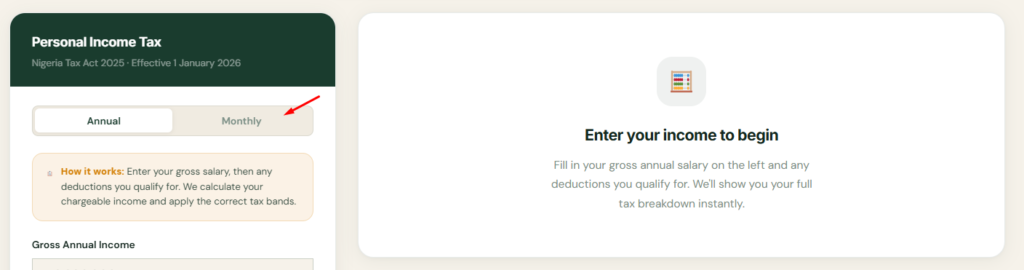
Type in your gross annual salary. If you know your monthly salary, toggle the calculator to “Monthly” and it will annualise it automatically. Gross means before any deductions, the full figure on your offer letter.
Step 2: Add Your Deductions
The calculator has fields for pension, NHF, NHIS, life insurance, and rent. For pension, if you leave it blank, it defaults to 8% of your gross (the statutory minimum). For rent relief, enter the full annual rent you pay and the calculator will apply the 20% rule and the N500,000 cap automatically.
Step 3: Hit Calculate
The calculator instantly shows you:
- Your total annual PAYE under the NTA 2025
- A band-by-band breakdown showing exactly how much tax falls in each bracket
- Your effective tax rate (your actual tax as a percentage of your gross income)
- Your estimated monthly take-home pay
- A side-by-side comparison with what you would have paid under the old PITA law
Real Examples: What Different Salaries Pay in 2026
Let us put some real numbers on this. The figures below assume the 8% statutory pension deduction and no other deductions, to keep the comparison clean. Your actual tax will be lower if you have NHF, rent relief, or health insurance deductions.
| Gross Annual Salary | Monthly Gross | Annual Tax (NTA 2025) | Monthly Tax | Effective Rate |
|---|---|---|---|---|
| N720,000 | N60,000 | N0 | N0 | 0% |
| N1,800,000 | N150,000 | N105,000 | N8,750 | 5.8% |
| N3,600,000 | N300,000 | N378,000 | N31,500 | 10.5% |
| N6,000,000 | N500,000 | N726,000 | N60,500 | 12.1% |
| N12,000,000 | N1,000,000 | N2,106,000 | N175,500 | 17.6% |
| N24,000,000 | N2,000,000 | N4,836,000 | N403,000 | 20.2% |
A few things worth noting from the table above:
- If you earn N60,000 a month or less, you pay zero income tax. Nothing. The full N720,000 annual salary sits within the tax-free band.
- A N300,000 monthly earner (N3.6m annually) pays about N31,500 per month in PAYE. Under the old system, that same person would have paid closer to N38,000. That is real money back.
- Higher earners above N50m annually will pay slightly more under NTA 2025 than the old law because of the new 25% top rate. But this affects a very small number of people.
Old Law vs New Law: Are You Paying More or Less?
For most Nigerians, especially those earning below N12 million a year, the NTA 2025 means lower tax. The jump from N300,000 to N800,000 as the tax-free threshold is the biggest single change. For someone earning N1.8 million annually (N150,000/month), that alone saves them over N70,000 in yearly tax.
For very high earners, it can go the other way. The old law’s top rate was 24%. The new law goes to 25%, and the CRA relief (which was generous for high salaries) has been replaced by the capped N500,000 rent relief. So a person earning N30 million or above might end up paying a little more, depending on their deductions.
The NairaSeed calculator shows you both figures side by side so you can see exactly where you land.
Common Questions About the 2026 PAYE Calculator
My employer has not updated my payslip yet. What should I do?
Employers were expected to update their payroll systems from January 2026. If your January payslip still showed old PITA rates, your employer is behind. You can calculate what you should be paying using the NairaSeed tool and have that conversation with your HR or payroll team.
What if I have allowances like housing, transport, and utilities?
All cash allowances are included in your gross income for PAYE purposes under the NTA 2025. Housing, transport, utilities, and any other regular cash payments all count. The NTA is explicit that the PAYE base covers all forms of remuneration. Enter the full package value, not just basic salary.
I am self-employed. Does this apply to me?
PAYE specifically applies to employees. But if you are self-employed or a freelancer with annual income above N800,000, you are still taxable under the NTA 2025. You would file directly with your State Internal Revenue Service. The tax bands are the same. The calculator can still give you a useful estimate.
What counts as chargeable income?
Chargeable income is your gross income minus approved deductions (pension, NHF, NHIS, rent relief, and life insurance). This is the figure the tax bands are applied to. It is almost always lower than your gross salary, which is why your effective tax rate is lower than the headline band rates.
Do not guess what your tax should be.
Use the NairaSeed Nigerian Tax Calculator to get your exact 2026 PAYE figure in under 60 seconds. Enter your salary, add your deductions, and see your full breakdown instantly, including a comparison with what you paid under the old law.
>> Calculate your exact 2026 take-home pay here
Disclaimer
The figures in this article are estimates based on the Nigeria Tax Act 2025 as published in the Federal Government Official Gazette (June 2025). Individual tax positions vary depending on employer structure, state of residence, and specific deductions applicable.
This article is for educational purposes only and does not constitute financial or tax advice. For personalised guidance, consult a qualified tax professional or your State Internal Revenue Service.